Cost Comparison: Professional Installation vs DIY Spray Foam Kits
Cost Comparison: Professional Installation vs DIY Spray Foam Kits In the world of home improvement and energy efficiency, few topics spark as much debate as insulation. Specifically, spray polyuret...
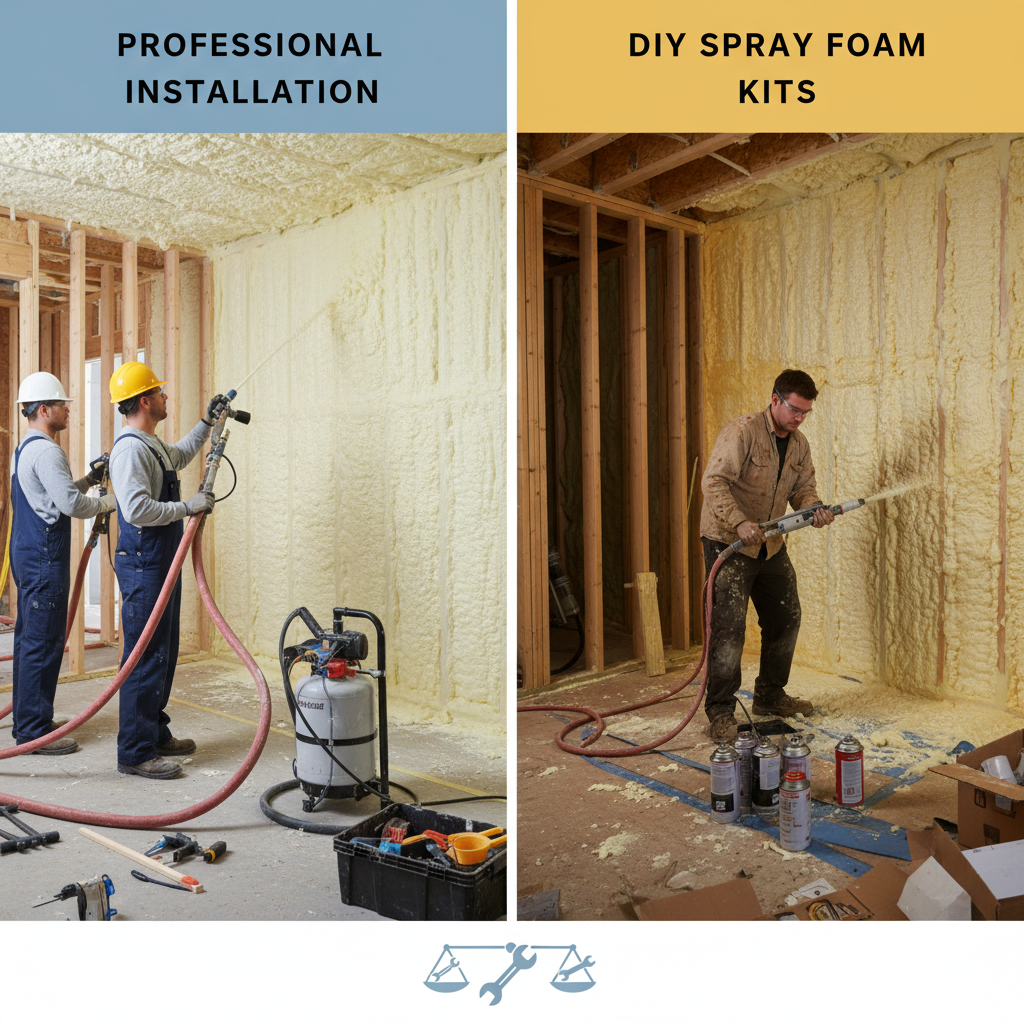
Cost Comparison: Professional Installation vs DIY Spray Foam Kits
In the world of home improvement and energy efficiency, few topics spark as much debate as insulation. Specifically, spray polyurethane foam (SPF) has emerged as the gold standard for sealing homes, reducing energy bills, and improving indoor comfort. However, its superior performance often comes with a sticker shock that sends homeowners scrambling for alternatives.
This search for savings inevitably leads to the "Do-It-Yourself" aisle of the local hardware store or online marketplaces, where DIY spray foam kits promise professional results at a fraction of the price. But is that promise true? When you peel back the layers of material costs, labor, equipment, risk, and long-term performance, the financial picture becomes much more complex.
In this comprehensive guide, we will conduct a deep-dive cost comparison between hiring a professional insulation contractor and tackling the job with DIY kits. We will analyze the math, the hidden variables, and the potential pitfalls to help you decide which route is truly the most cost-effective for your specific project.
Part 1: Understanding the Product
Before we can compare costs, we must understand what we are buying. Not all spray foam is created equal, and the type of foam you choose significantly impacts the price and the application method.
The Metric: What is a Board Foot?
In the insulation industry, pricing is rarely calculated by the square foot alone because the thickness of the insulation matters. Instead, we use the term "board foot."
A board foot is a unit of volume measurement defined as a square foot of area that is one inch thick (12" x 12" x 1").
- If you spray 1,000 square feet of wall at 1 inch thick, you have installed 1,000 board feet.
- If you spray that same 1,000 square feet at 3 inches thick, you have installed 3,000 board feet.
Understanding this metric is crucial because DIY kits are sold by board footage (theoretical yield), and professionals quote by board footage (installed volume).
Open-Cell vs. Closed-Cell Foam
There are two primary types of spray foam, and they have vastly different price points:
- Open-Cell Foam: This is lighter, sponge-like, and expands significantly (often 100x its liquid volume). It is excellent for soundproofing and is generally cheaper. However, it is not a vapor barrier and has a lower R-value per inch (around R-3.5).
- Closed-Cell Foam: This is dense, rigid, and acts as a moisture vapor barrier. It adds structural integrity to walls and has a very high R-value per inch (around R-6.0 to R-7.0).
Crucial Note for Comparison: Most DIY kits sold in hardware stores are closed-cell foam. However, professionals often install open-cell foam in residential walls and attics because it is more cost-effective for large spaces. When comparing quotes, ensure you are comparing apples to apples (closed-cell to closed-cell) or understand why the professional is recommending a different product.
Part 2: The Economics of DIY Spray Foam Kits
The allure of the DIY kit is obvious: you cut out the middleman. No labor costs, no overhead, no scheduling conflicts. You simply buy the box, point, and shoot. Let’s break down the financial reality of this approach.
The Upfront Cost of Kits
DIY spray foam kits typically come in two pressurized tanks (Side A and Side B) connected by hoses to a dispensing gun. These are often referred to as "Froth-Paks" or similar brand names.
As of current market rates, a standard "600 board foot" kit usually costs between $750 and $950 depending on the brand and retailer.
Doing the math:
- Cost: $850 (average)
- Yield: 600 board feet
- Price Per Board Foot: $1.42
On the surface, $1.42 per board foot seems reasonable. However, this calculation assumes a "perfect yield," which leads us to the hidden costs of DIY.
The "Theoretical Yield" Fallacy
The "600" on the box represents the maximum theoretical yield under laboratory conditions. These conditions include perfect temperature (both ambient and chemical), perfect pressure, and perfect application technique.
In the real world, first-time users rarely achieve the full yield. Common issues include:
- Temperature fluctuation: If the tanks are too cold, the chemicals won't react properly, resulting in less expansion.
- Changing tanks: You may run out of one tank before the other due to pressure imbalances, rendering the remaining chemical useless.
- Overspray and Waste: Professionals can spray a smooth, consistent layer. DIYers often spray unevenly, requiring them to shave off excess foam (which is wasted money) or resulting in areas that are too thick while others are too thin.
Realistically, a DIYer should expect a 10% to 20% loss factor. If you only get 500 board feet out of an $850 kit, your cost jumps to $1.70 per board foot.
The Hidden Accessories Bill
The kit includes the chemicals and the hose, but you cannot safely or effectively install spray foam with just the box. You must purchase additional supplies:
- Personal Protective Equipment (PPE): Spray foam is comprised of isocyanates. You absolutely need a high-quality respirator (not a dust mask), a full-body Tyvek suit, goggles, and chemically resistant gloves. Estimated cost: $100 - $150.
- Prep Materials: Plastic sheeting to cover floors and windows, masking tape, and drop cloths. Spray foam sticks to everything and is nearly impossible to remove once cured. Estimated cost: $50 - $100.
- Cleaning Solvents: Acetone or specialized foam cleaners for the gun (if reusable) or for accidental spills. Estimated cost: $20.
When you add these "hidden" costs to a single kit project, the price per board foot continues to climb.
Part 3: The Economics of Professional Installation
Hiring a professional contractor involves a different pricing structure. You are paying for the material, but you are also paying for the "Rig"—a $50,000 to $100,000 mobile factory on wheels—and the skilled labor to operate it.
Economies of Scale
Professional spray foam rigs purchase chemicals in 55-gallon drums or large totes. Because they buy in bulk directly from manufacturers, their material cost is significantly lower than the pre-packaged, pressurized disposable tanks sold to consumers.
While a DIYer pays for the expensive packaging and propellant of a kit, the pro pays strictly for the chemical. This allows professionals to offer competitive pricing despite their labor overhead.
Typical Professional Pricing
Pricing varies wildly by region, job complexity, and total volume, but general national averages are:
- Open-Cell Foam: $0.40 to $0.65 per board foot.
- Closed-Cell Foam: $1.00 to $1.50 per board foot.
Wait, look at those numbers again.
If a professional charges $1.25 per board foot for closed-cell foam, and the DIY kit costs $1.42 (or $1.70 with waste) per board foot, the professional is often cheaper on paper for the raw installation of closed-cell foam.
However, there is a catch: Minimum Job Charges.
Most professional companies have a minimum charge to roll a truck. It costs them money to drive the rig to your house, heat up the chemicals, prep the hoses, and pay the crew. This minimum charge is often between $2,000 and $3,000.
Part 4: The Showdown – Three Scenarios
To truly understand the cost comparison, we must apply these numbers to real-world scenarios. The "winner" of the price war depends almost entirely on the size of the project.
Scenario A: The Rim Joist (Small Project)
The Project: You want to insulate the rim joists (the perimeter of the basement ceiling) to stop drafts.
Volume Needed: Approximately 250 board feet.
DIY Cost:
You buy one "200 board foot" kit and one "100 board foot" touch-up kit (or a single large kit to be safe).
Kits: $450
Supplies (PPE/Plastic): $100
Total DIY Cost: $550
Professional Cost:
The volume is small, so the price per board foot is irrelevant. You will be hit with the minimum trip charge.
Total Pro Cost: $2,000+
Winner: DIY. For very small projects, touch-ups, or sealing rim joists, DIY kits are the clear financial winner.
Scenario B: The Crawl Space or Bonus Room (Medium Project)
The Project: Encapsulating a medium-sized crawl space or insulating a bonus room over a garage.
Volume Needed: Approximately 1,800 board feet.
DIY Cost:
You need three "600 board foot" kits.
Kits ($850 each): $2,550
Supplies: $150
Waste Factor (buying a 4th kit just in case): $850
Total DIY Cost: $2,700 - $3,550
Professional Cost:
At 1,800 board feet, you are likely approaching or surpassing the minimum charge. If the pro charges $1.50 per board foot for closed-cell:
1,800 x $1.50 = $2,700.
Total Pro Cost: $2,700
Winner: TIE / Professional. At this size, the costs converge. However, considering the labor you save and the guarantee of quality, the professional is the better value.
Scenario C: The Whole Home or Large Attic (Large Project)
The Project: Insulating the roof deck of a large attic or the walls of a new construction home.
Volume Needed: 5,000 board feet.